

Inventory Without Excel: Digital Tools Solve These Problems
Key Takeaways
- 18% of assets are untraceable during internal audits because inventory data is outdated or incomplete (KPMG, 2024).
- 41% of audit findings arise from manually managed asset lists (ISACA, 2024).
- 73% of ERP users continue to maintain Excel lists in parallel, mostly due to a lack of system integration (Forrester, 2023).
- Digital inventory via app solves the three biggest Excel weaknesses: error-prone input, missing system integration, and no up-to-date overview.
What is an inventory and why is Excel often no longer sufficient?
An inventory is the systematic recording of all assets and liabilities of a company on a specific key date or continuously as part of a perpetual inventory. It forms the basis for the annual financial statements according to § 240 HGB and is therefore legally binding, not optional. Excel spreadsheets only provide a snapshot: As soon as an asset's location, condition, or responsibility changes, the entry becomes outdated without anyone noticing.
This is precisely where the biggest gaps arise in practice. During internal audits, 18% of recorded assets cannot be found because inventory data was outdated or incompletely maintained (KPMG, 2024). This affects not only IT equipment but also tools, furniture, and conference technology – precisely the assets typically managed with Excel.
What specific problems arise during inventory with Excel?
The most common source of error is not the Excel software itself, but the manual process behind it: values are transferred manually, rows shift, and files are overwritten. Three problems occur particularly regularly.
Error-prone manual data entry
Anyone who manually transfers inventory data into a table inevitably produces transfer errors: wrong row, wrong column, accidentally overwritten values. With digital recording via photo or scan, this step is completely eliminated because the input mask provides predefined fields for type, quantity, and value.
Missing integration with SAP, DATEV, or Microsoft systems
Excel lists usually exist in isolation alongside the actual ERP system. This precisely explains why 73% of ERP users continue to maintain Excel lists in parallel (Forrester, 2023): the interface is missing, so data is maintained twice. Every duplicate maintenance is an additional source of error and a time loss that no one accounts for.
No up-to-date overview of missing assets
When was an item last inventoried? What about assets that could not be found during the last count? In an Excel spreadsheet, these questions remain unanswered because there is no automatic history. The result regularly only becomes apparent during the next audit: 41% of audit findings arise from manually managed asset lists (ISACA, 2024).
On average, how many assets cannot be found during a classic Excel inventory?
In internal audits, an average of 18% of recorded assets are untraceable because inventory data is outdated or incompletely maintained (KPMG, 2024). Digital recording with automatic location history significantly reduces this risk. seventhings automatically maps this history for tools, furniture, and conference technology.
How does inventory management with an app differ from a cut-off date inventory?
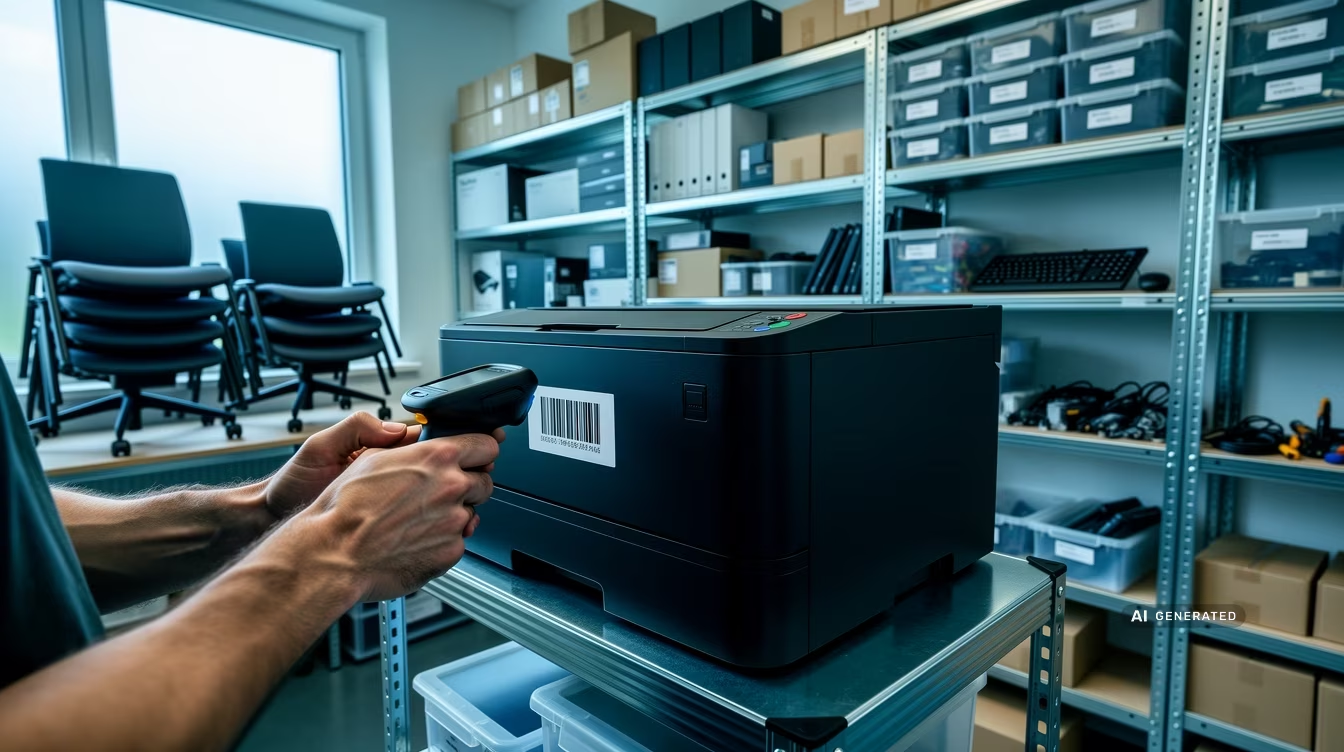
With cut-off date inventory, the entire stock is recorded on a fixed date, typically at the end of the fiscal year. Perpetual inventory, on the other hand, distributes the recording throughout the year, with each asset counted at least once annually and documented in a continuously maintained inventory register. An inventory app supports both methods: each item receives a label with a unique serial number, which is scanned using a smartphone camera. Location, condition, and responsibility are documented directly on-site, not retrospectively at a desk.
Experience with mid-sized facility teams reveals a recurring pattern: the switch from Excel to app-supported inventory is rarely initiated out of strategic foresight, but rather after a specific audit result or a failed cut-off date inventory. Those who clarify their recording method beforehand avoid precisely this reactive, time-pressured transition.
What is the difference between cut-off date inventory and perpetual inventory?
Cut-off date inventory records the entire stock on a fixed date, usually at year-end. Perpetual inventory distributes the counting throughout the year, with each asset recorded at least once annually. seventhings supports both inventory types using the same mobile recording method.
What legal requirements must inventory management fulfill?
The obligation to conduct an inventory arises directly from the German Commercial Code (HGB): Section 240 HGB requires the complete recording of all assets and liabilities at the end of the fiscal year, while Section 241 (1) HGB permits perpetual inventory as an alternative to a pure cut-off date count under certain conditions. For the annual financial statements, it is not only important that a count has taken place, but also that it is comprehensibly documented, including the type, quantity, and value of each item.
Real-time asset data directly impacts the financial closing process: companies with continuously updated inventory data significantly shorten their closing cycles compared to companies that only count on the cut-off date (Deloitte Financial Close, 2024). Distributing the inventory count throughout the year also eases the burden on accounting during the already labor-intensive closing period.
What legal requirements apply to inventory management under the HGB?
Section 240 HGB obliges companies to fully record all assets at the end of the fiscal year, while Section 241 (1) HGB permits perpetual inventory as an alternative under certain conditions. Digital recording with history automatically fulfills both documentation requirements. For the asset accounting , seventhings provides the necessary data basis directly from the mobile recording.
How to transition from Excel to inventory software?
The most reliable way to transition is in three steps: first, clean up the existing Excel list and verify the actual inventory, then define labels and the data capture process for all locations, and finally implement the software. In this Help Center article we provide a clear guide for successfully working with seventhings.
In practice, teams regularly underestimate how much time the migration of existing Excel data alone costs; this is a separate planning item that is rarely actively discussed in sales meetings.
Important to note: Not every asset belongs in the same category. Mobile equipment such as tools, PPE, conference technology, or furniture can be reliably managed with an inventory solution like seventhings. For stationary production facilities or machines with their own maintenance control, however, CAFM or MDM systems are the right category; inventory software does not replace these.
What now?
- Verify current inventory. Get an overview of how up-to-date your existing Excel list actually is before deciding on a new system.
- Request asset potential analysis. A free asset potential analysis shows how much time and cost potential lies in a digital perpetual inventory for your company.
- Book a demo with your own assets. Test mobile data capture with real equipment instead of demo data.
Frequently Asked Questions
Is perpetual inventory legally permissible even without an app?
Yes, Section 241 (1) HGB allows perpetual inventory regardless of the tool used, as long as the recording is clearly documented. An app simplifies documentation, but it is not a legal requirement.
Which assets can be tracked with an inventory app like seventhings?
Suitable assets include mobile equipment such as tools, PPE, conference equipment, furniture, and company phones without MDM. This solution is not suitable for stationary production facilities or devices with their own MDM management.
How long does the migration of an existing Excel list take?
That depends on the data quality of the existing list. Initial assets can usually be digitally captured within two weeks, while a complete migration including cleanup takes longer depending on the scope.
Can inventory software be integrated with SAP or DATEV?
Yes, via standardized interfaces inventory data can be synchronized with SAP, DATEV, or Microsoft systems, eliminating duplicate data entry. Details on the specific connection are part of every initial consultation.

.avif)












.svg)

.svg)
.svg)