

8 Types of Barcodes & How You Can Use Them for Inventory Management
A barcode... what exactly is it and how does it work? Most people think of the barcode scanned at the supermarket checkout before an item goes into their shopping bag. As an industry standard, barcodes help to precisely identify products. They serve as identifiers and provide access to databases containing all important information such as price, product name, category, quantity, etc. – so it's more than just a few lines. That's why we're providing an overview of the different types of barcodes and how we use them to keep inventory management as efficient as possible.
If you want to manage your inventory effectively, it's advisable to establish a quick, simple, and unique identification system for all items. seventhings has developed a process to support you in this. We equip you with labels, smartphone apps, and an intuitive web interface so you can manage your inventory quickly and efficiently. We've compiled everything you need to know about managing your inventory in our blog.
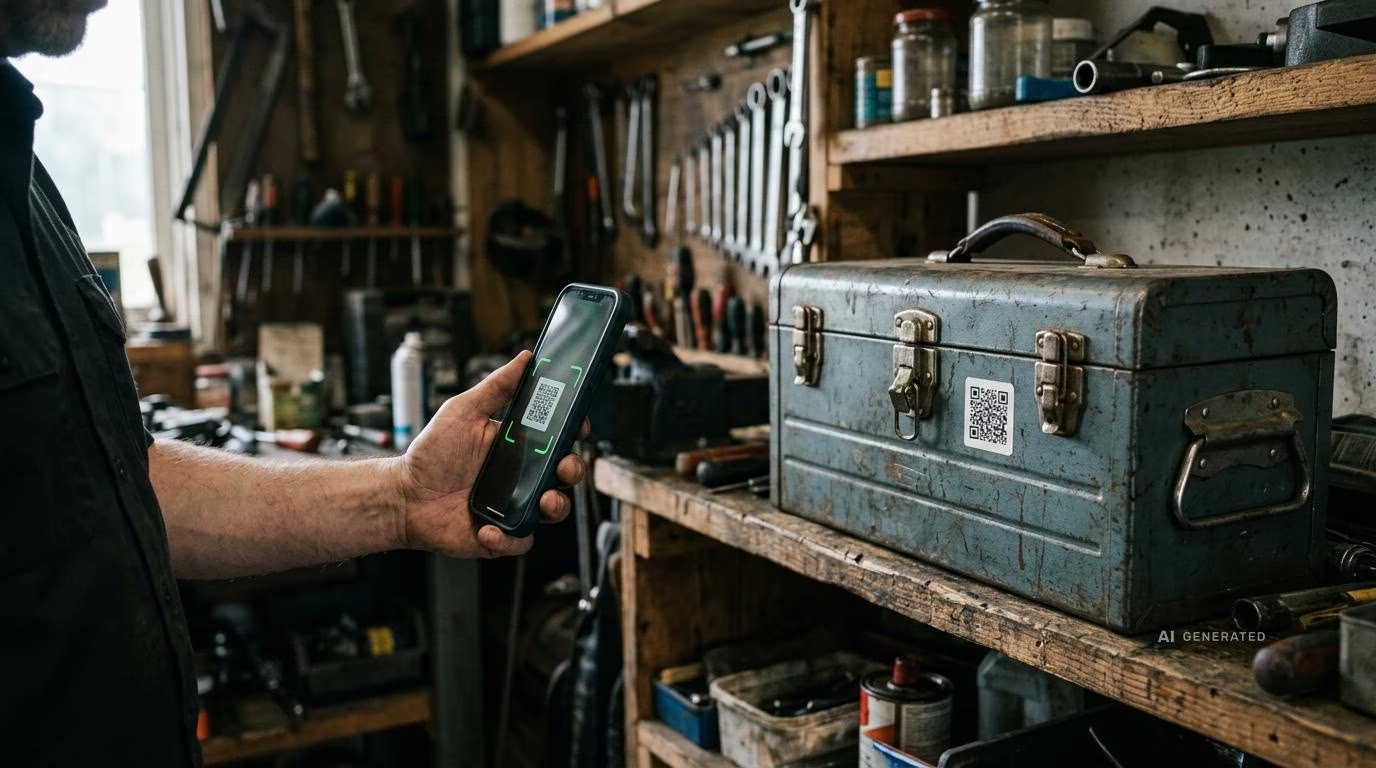
Labels are a crucial aspect of digital inventory management. You simply affix them to all inventory items, allowing you to then scan them with a smartphone or specialized industrial scanners to record and uniquely identify the item. A barcode is printed on these labels, which is then read by an end device.
One-Dimensional Codes
This code consists of black and white bar codes. All information is stored here in a series of lines on a light background. This code begins with a start and a stop character, and the information is defined by the varying widths of the parallel bars and spaces. The data structure is ISO-certified. We will now explain the most important 1D codes:
Code 39
Structure: Simply put, Code 39 can represent numbers (0-9), letters, and some symbols. This type of barcode can be used for lengths up to 49 characters. In simple terms, each character has its own pattern of bars and spaces.
Applications: Its primary application is likely factory automation, especially in the automotive industry, where Code 39 is standard because it can also represent letters. The AIAG (Automotive Industry Action Group) has even standardized Code 39 in the USA.
Code 128
Structure: In addition to what Code 39 can represent, it can also distinguish between uppercase and lowercase letters and represent certain control characters (CR, STX, etc.). Code 128 allows for a minimal size representation, as long as only numeric characters are used.
Applications: We are all familiar with Code 128 from the supermarket, as it is primarily used in the food industry. Code 128 is also common and widely used in medicine.
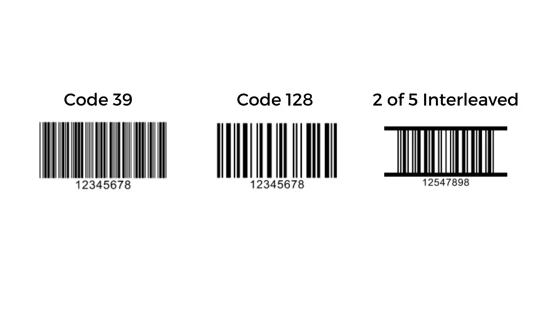
Interleaved 2 of 5
Structure: Unlike the codes mentioned above, "2 of 5 Interleaved" can only represent digits from 0 to 9. Furthermore, the number of digits must be even, which is why a "0" is prepended or a check digit is appended.
Applications: Since this type of barcode can be read by virtually all barcode scanners, it is frequently used in logistics and by parcel services. Serial numbers and batch numbers are also often represented internally within companies using this code.
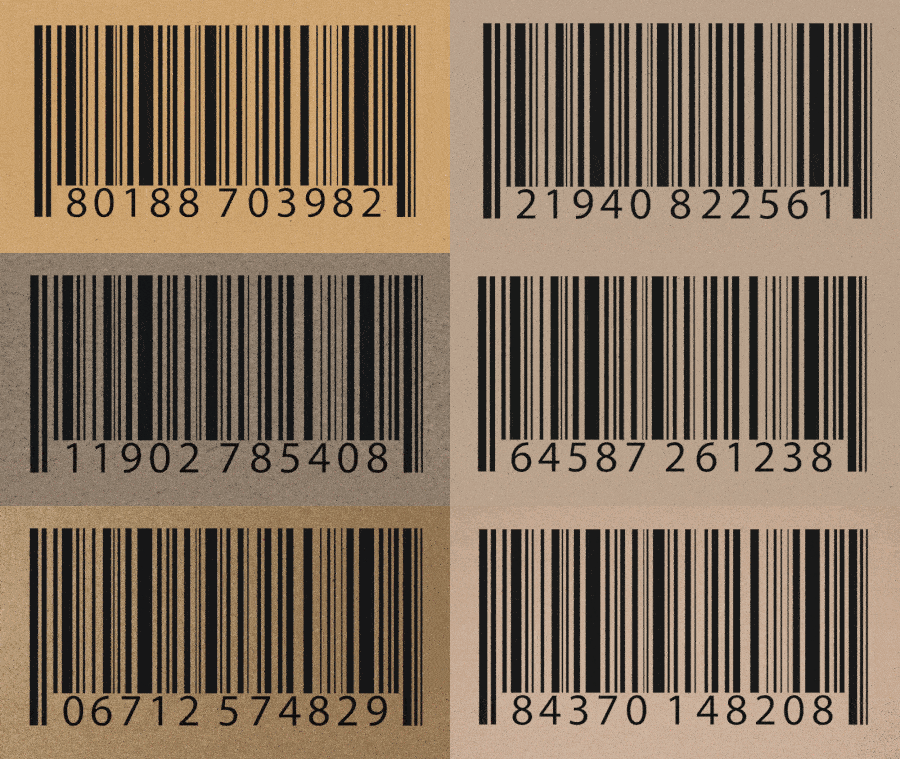
Universal Product Codes (UPC)
Structure: This is also a barcode that uses only numbers.
Applications: Traditionally used format in the USA. Therefore, a desirable format for product sales in the USA.
International Article Number
Structure: The international counterpart to the UPC format. Also known as Global Article Identification Number. Formerly known as European Article Number (EAN), it has been referred to as Global Trade Item Number (GTIN) since 2009.
Examples of Use: Used almost everywhere and on every product. Whether it's the ISBN identifier of a book or any commercial products (clothing, food, stationery, electronic devices, etc.).
Two-Dimensional Codes
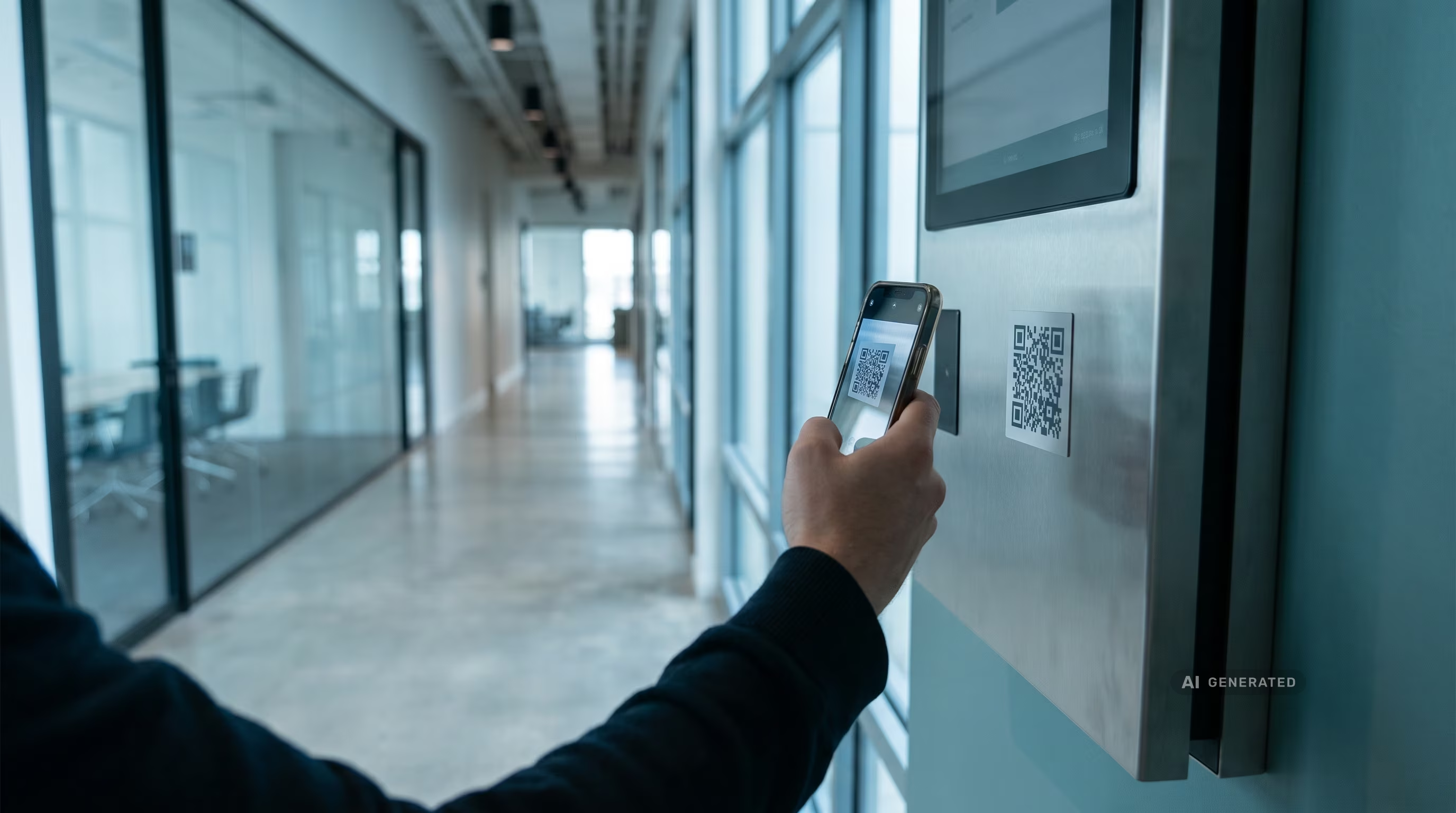
These codes typically consist of square patterns. The most well-known example is the QR code, which is widely used due to its readability, for instance, via mobile devices, making it accessible to virtually anyone with a smartphone. The main advantage is the significantly higher density of information that can be read. Therefore, they are also widely used in industrial applications. They are categorized into stacked, matrix, or dot codes.
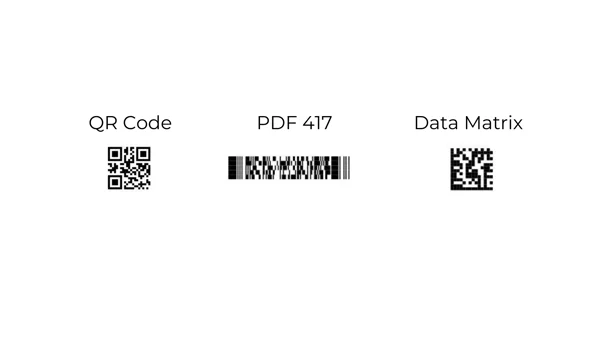
PDF 417
Structure: A PDF 417 code can be understood as a bidirectional "D-barcode". It also has a variable length and can contain both numeric and alphanumeric characters. The use of a specific algorithm for reading is beneficial. This allows the code to be read even with 50% damage.
Examples of Use: We all encounter the PDF 417 code on boarding passes, some packages, and also on official documents like driver's licenses.
Data Matrix
Structure: Described as a high-density barcode symbol, a Data Matrix code encodes text, numbers, files, and data bytes. This code has been standardized and recognized by ISO/IEC 16022 since 2000.
Examples of Use: Typically used on smaller packaging, but also on posters, various electronic items, and other packaging.
Quick Response (QR) Code
Structure: Probably the most well-known code, designed so that not only scanners but also any camera can read it. It has the highest character capacity and, like the Data Matrix & PDF 417 codes, can use all numeric, alphanumeric characters, and data bytes. The online platform heise.de has explained how to read QR codes from an image in this article very well.
Examples of Use: Any online and app payments, AR applications, website login, virtual shopping – the QR code makes almost anything possible.
Why does seventhings use barcodes and which barcodes do we use?
Barcodes are incredibly helpful for inventory management. Instead of tedious searching for serial numbers or other identification features, all inventory items can be easily identified. Using adhesive labels and appropriate labeling guidelines can save a significant amount of time during inventory management.
To make it as easy as possible, labels are included in all seventhings pricing packages – so there are no additional costs. The labels are equipped with QR codes and are printed with our customers' logos. This offers the advantage that inventory can be managed with almost any smartphone. When used correctly, scanning is possible even if up to 30% of the code area is damaged.
Would you like to try out how easy inventory management can be with seventhings? Then we invite you to a free 14-day trial period.












.svg)

.svg)
.svg)