
Key Takeaways
- Five key points are crucial when comparing software: mobile data capture, integration with SAP/DATEV, customizable fields, data protection under EU law, and features for circular reuse.
- seventhings covers these five points for assets without IoT sensors, such as tools, PPE, conference equipment, or furniture.
What defines inventory software?
Inventory software centrally records physical assets like tools, furniture, or conference equipment, making their location, condition, and responsibility accessible at any time. The difference from a classic Excel list lies in three points: mobile capture via photo or scan, automatic history tracking with every location change, and an interface to existing systems like SAP or DATEV. Without these three points, any inventory list remains a snapshot that becomes outdated with the next relocation or employee change.
What criteria are crucial when comparing inventory software?
When comparing software, five criteria matter more than any single feature: mobile data capture without media disruption, interfaces to existing software, individually customizable fields, GDPR-compliant hosting in the EU, and functions for the later reuse of assets. Those who only look at the range of functions and overlook these five points often purchase a solution that, while capable, is not used in daily operations.
1. Mobile Data Capture Without Media Disruption
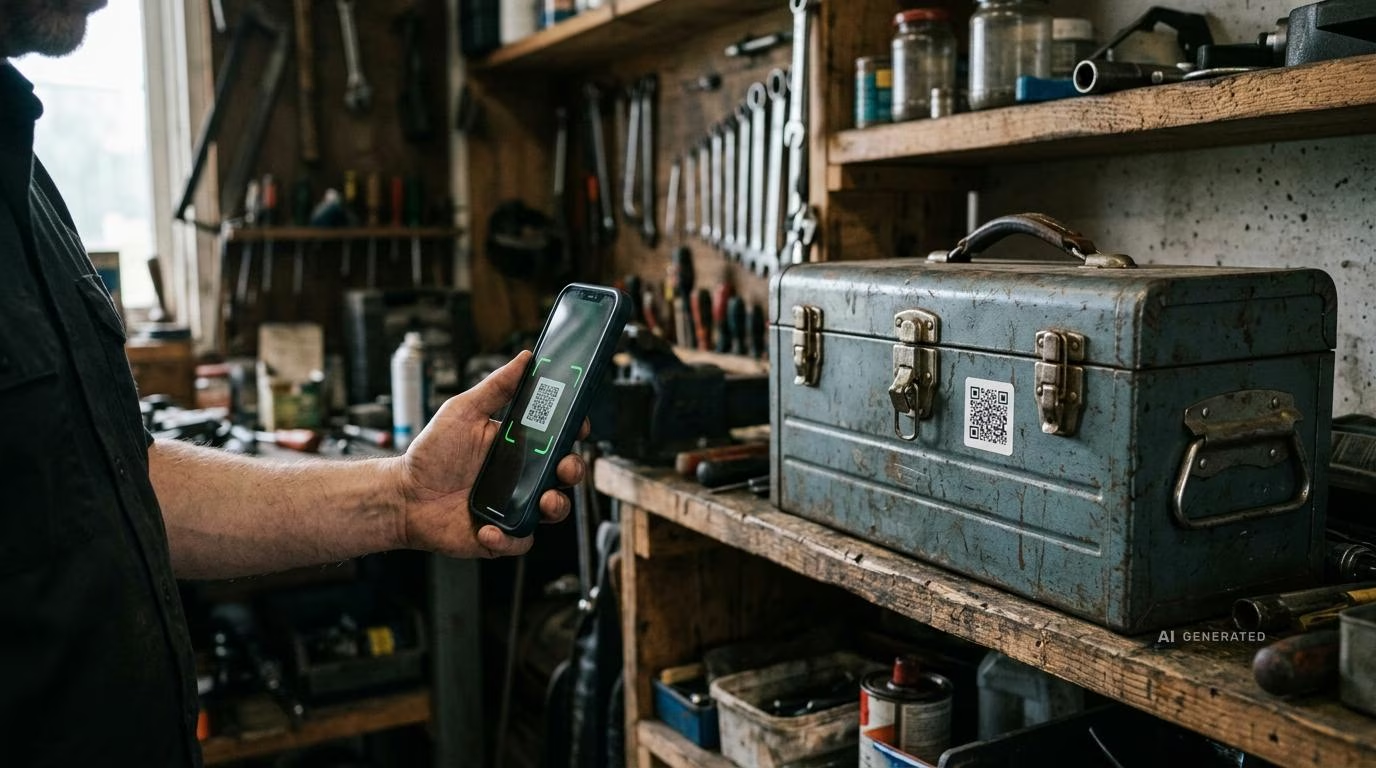
An asset is recorded via smartphone camera, not by subsequent entry at a desk. This reduces the error rate because location and condition are documented directly on-site. An offline function is mandatory: warehouses and construction sites rarely have continuous Wi-Fi.
2. Integration with SAP, DATEV, or Microsoft
Inventory software does not replace an ERP system; it complements it. The crucial factor is whether inventory data can be synchronized via an interface with SAP, DATEV, or Microsoft systems without requiring duplicate data entry. 73% of ERP users continue to maintain Excel lists in parallel (Forrester, 2023), mostly because this specific integration is missing.
3. Individually Customizable Fields
A facility manager needs different data fields than an IT manager or a buyer. Check whether categories, mandatory fields, and views can be customized without developer resources. Rigid field structures are one of the most common reasons why inventory projects fall dormant after implementation.
4. Data Protection and Hosting Location
Where customer data is stored and who processes it is a compliance issue for physical assets with personal references (e.g., assignment to employees). Specifically inquire about the hosting location, data processing agreement, and certifications, rather than relying on general statements about data security.
5. Functions for Reuse and ESG Reporting
CSRD and Scope 3 reporting obligations increasingly require asset data as a basis for CO₂ calculations. Inventory software should not only record assets but also be able to document their reuse, sale, or donation. This provides the data basis for Scope 3 calculations but does not replace independent CO₂ accounting.
How much does inventory software cost for mid-sized companies?
Prices depend on the number of users and assets, typically ranging from a few hundred to a few thousand euros per month for companies with 200–5,000 employees. Unused equipment costs an SME an average of €50,000–€200,000 per year (McKinsey, 2024), meaning an investment often pays for itself within a few months. seventhings calculates the volume individually as part of a free asset potential analysis.
What types of inventory software providers are there?
Roughly three categories can be distinguished in the market: pure ERP add-on modules, specialized CAFM systems for building technology, and lean middleware solutions for mobile, non-networked assets. The choice depends on whether the primary focus is managing building infrastructure or movable equipment like tools and furniture. seventhings positions itself in the third category, complementing ERP and CAFM rather than replacing them.
Is inventory software worthwhile even for smaller asset bases?
With just a few hundred assets, a dedicated solution usually pays off faster than expected, as search time and duplicate purchases increase linearly with the number of assets. 41% of audit findings for manually maintained asset lists are due to missing or outdated entries (ISACA, 2024). For this reason, seventhings is often implemented during a company's growth phase, rather than waiting until there are several thousand assets.
Conversations with maintenance managers in mid-sized companies reveal a recurring pattern: the trigger for seeking software is rarely strategic planning, but rather a specific audit result or a failed inventory count. Clarifying the five criteria above beforehand significantly shortens the selection phase, as the list of providers is often halved after just the second criterion.
A second practical point: teams regularly underestimate the time required for data migration from existing Excel lists. Therefore, a clean transfer of existing data is a selection criterion in itself, one that is rarely actively discussed in sales meetings.
How does seventhings fit into this comparison?
seventhings covers the five criteria mentioned for assets without IoT sensors: mobile capture via app, interfaces to SAP, DATEV, and Microsoft, freely configurable fields, hosting in Germany via the Open Telekom Cloud, and an integrated Circularity Hub for selling, donating, or refurbishing decommissioned assets. The platform is deliberately not a replacement for ERP or CAFM systems, but rather fills the gap for mobile tools, DGUV-V3 operating equipment, PPE, conference technology, furniture, and pool vehicles without telematics.
seventhings is not the right choice for stationary building technology, production facilities, or devices with their own MDM management; in these cases, CAFM or MDM systems are the appropriate category.
What now?
- Align criteria list internally. Clarify with Facility Management, IT, and Purchasing which of the five criteria are mandatory for your company.
- Request asset potential analysis. A free asset potential analysis shows how much untapped capital lies within your current inventory.
- Book a demo with real assets. Test mobile data capture with your own equipment instead of demo data.
Frequently Asked Questions
What distinguishes inventory software from an Excel spreadsheet?
Inventory software captures assets on the go via photo or scan, automatically documents every location change, and can be integrated with SAP or DATEV. An Excel spreadsheet, on the other hand, only reflects a single point in time and becomes outdated with every movement.
Is seventhings also suitable for IT devices?
Yes, but only for devices without their own MDM management, such as company phones or tablets in a simple rollout. Laptops and smartphones with an active MDM system are already managed via MDM and are not a use case for seventhings.
How long does it take to implement inventory software?
The duration depends on the number of assets and the data quality of existing lists. Initial assets can usually be recorded within two weeks, while a complete migration of existing data takes longer depending on the scope.
Can inventory software be integrated with SAP or DATEV?
Yes, inventory data can be synchronized with SAP, DATEV, or Microsoft systems via standardized interfaces, eliminating the need for duplicate data entry. Details on specific integration options are part of every initial consultation.

.avif)











.svg)

.svg)
.svg)