
Live in 7 days: Implement asset software without an IT project
Key Takeaways
- A central asset database can be set up without an IT project if migration and rollout are broken down into clearly separated daily steps.
- 73% of ERP users continue to maintain Excel lists in parallel (Forrester, 2023) – migrating from these very lists is the actual starting point, not a fresh start.
- A first maintenance plan for an asset group can realistically go live within 7 working days if the focus is on a manageable pilot group.
- Mobile scan capture reduces manual data entry by up to 92% compared to spreadsheet-based maintenance (Forrester, 2023).
Seven days, an Excel spreadsheet with 1,200 rows, and no budget for an IT project – that's the starting point for most maintenance managers in mid-sized companies. No requirements specification, no kick-off with the IT department, no three-month rollout. Nevertheless, within this period, a central, searchable asset database with the first active maintenance plan is created.
This article describes exactly this path: from the inventory of the Excel file on Monday to the first documented maintenance operation the following Monday. Without implementation partners, without server migration, without training days in a conference room.
Why do traditional asset software implementations fail?
Traditional implementation projects rarely fail due to the software itself, but rather due to the project framework. As soon as a project is declared an "IT project," a requirements specification, steering committee, interface concept, and a multi-month timeline automatically emerge.
For most physical assets in seventhings' sweet spot – mobile tools, testing equipment, PPE, conference technology, furniture – this framework is oversized. These assets have no IoT connection, no interface to machine control, and no dependency on production-critical systems. They can be recorded without needing to touch an ERP or CAFM system.
Why do traditional asset software implementations often take several months?
Traditional implementations are often organized as IT projects with requirements specifications, interface concepts, and multi-stage coordination – regardless of whether the assets concerned actually require system connections. For mobile, non-networked assets, this effort is usually not necessary. seventhings is designed as middleware so that data capture can start independently of the ERP project plan.
In 2023, Forrester investigated how companies actually work with asset data today. Automated asset platforms reduce data entry errors by 92% compared to spreadsheets, and 73% of ERP users still use Excel in parallel. This means: The Excel spreadsheet is not the problem to be solved. It is the data source with which the project begins.
What does it really take to get started in 7 days?
Three prerequisites are sufficient: a pilot group of assets, an existing list (regardless of its condition), and a person who knows this list. IT approval, a server, or an interface to the ERP are not required to get started.
The pilot group should be manageable – approximately 50 to 150 assets from an area that regularly requires maintenance or inspections. Typical candidates include DGUV-V3-compliant operating equipment, test equipment with calibration intervals, or conference technology across multiple locations. The seven-day implementation has been proven in practice precisely for these asset classes; this framework does not apply to stationary systems with building management technology or production lines.
Which asset group is best suited for the first 7-day sprint?
Suitable assets include those with recurring inspection or maintenance needs and a manageable number – such as test equipment, DGUV-V3 operating equipment, or conference technology. In practice, a pilot group of 50 to 150 assets can be fully recorded and linked to an initial maintenance plan within one week, without the need to involve other departments.
Our article on how inspection intervals for precisely these asset classes can then be centrally planned describes Maintenance Planning and Interval Control in detail.
Day 1–2: The Excel Spreadsheet Becomes the Data Foundation
The first step is not a migration in the technical sense, but a cleanup. Most asset lists contain duplicates, outdated locations, and inventory numbers that no one can assign anymore.
On Day 1, the existing Excel file is converted into a uniform import format: columns for designation, location, responsible person, acquisition date, and – if available – the previous inventory number. Missing fields are initially left blank, not guessed. On Day 2, the import into the central database takes place. Each asset automatically receives a QR code or, depending on the area of application, an RFID label.
Does the Excel list have to be complete and error-free before import?No. A complete cleanup before import unnecessarily delays the start. More important is a unique designation per asset, based on which a QR or RFID code can be assigned. Missing information such as location or responsible person will be added during the scan acquisition in the following days – seventhings specifically supports this iterative development of the data foundation.
The question of how much data quality is needed at the beginning concerns almost every team. From experience: A unique designation is sufficient to start. Everything else – location, condition, photo, responsibility – is added during on-site acquisition, not beforehand in the office.
Day 3–4: On-site Scan Acquisition Instead of a Second Excel Round
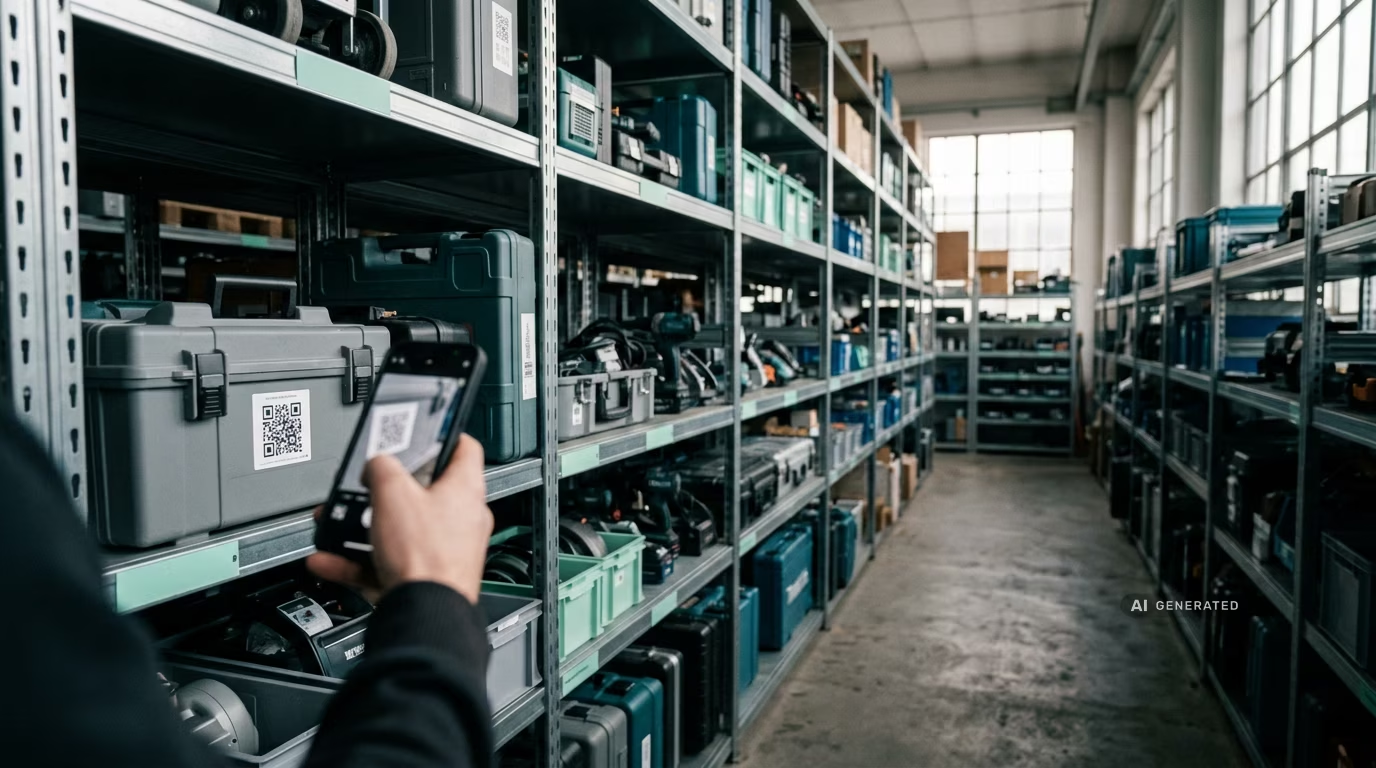
Days 3 and 4 take place on-site – at the locations where the pilot group is situated. Employees scan each asset with a smartphone, confirm or correct the imported data, and add a photo as well as the current location.
For mobile tools and test equipment, RFID has proven to be an effective acquisition technology as soon as larger quantities need to be recorded in a short time: RFID tags can be read from 4 to 6 meters away without line of sight and even through materials, which significantly speeds up the acquisition. NFC remains a useful addition for individual, high-value assets with frequent status changes – for example, conference technology that regularly moves between rooms.
How long does it take to acquire 100 assets on-site?With mobile scan acquisition, approximately 100 assets in the pilot group can typically be recorded within one working day, provided the preparatory work from Days 1–2 is completed. RFID bulk scanning further accelerates this process for larger quantities, as multiple tags are detected simultaneously and without line of sight. seventhings supports both acquisition methods depending on the asset type.
This is where the real difference from Excel management becomes apparent: The data is generated where the asset is located – not retrospectively at a desk. Anyone who has ever tried to transfer a 17-digit inventory number from one Excel cell to another knows how many errors can occur. Precisely these transfer steps are eliminated.
Day 5: Define maintenance intervals for the pilot group
With recorded assets and complete master data, the first maintenance plan can be set up on Day 5. For DGUV-V3 operating equipment and test equipment, intervals are usually already defined by legal requirements or manufacturer specifications – they only need to be entered once.
Each asset in the pilot group receives an inspection interval (e.g., annually for DGUV-V3) and a responsible person. From this point on, the system automatically generates reminders as soon as an inspection is due – without manual schedule management in a separate calendar.
Can existing inspection intervals be adopted from the old Excel list?
Yes, if the old list contains interval information, this can be directly adopted and assigned to the respective assets. If information is missing, legally prescribed intervals, such as for DGUV-V3 inspections, can be stored based on the asset category. This creates a central overview of all due inspections for the pilot group from Day 5 onwards.
McKinsey quantified in 2024 the volume of unused or poorly managed equipment in medium-sized companies: McKinsey 2024: 50,000 to 200,000 Euros of unused equipment per SME. A structured maintenance plan for the pilot group is a first, measurable step to make this value visible – not for the entire fixed assets at once, but for a clearly defined area.
Days 6–7: The first maintenance operation is documented
On Day 6, the first due inspection or maintenance is actually carried out – provided that one of the recorded assets already has a near due date, or is deliberately brought forward to complete the process once. The responsible person scans the asset, documents the maintenance status directly on the device, and completes the process.
By Day 7, a complete, audit-proof documented run-through is available: from the asset in the Excel list, through on-site recording, to completed maintenance with a timestamp. This run-through is the actual milestone – not the number of recorded assets, but proof that the process works from start to finish.
What exactly does "live" mean after 7 days?
"Live" means that a pilot group of assets has been fully recorded, a maintenance plan with intervals is actively running, and at least one maintenance operation has been documented. The expansion to further asset groups, locations, or integration with ERP systems then takes place iteratively, without interrupting the ongoing operation of the pilot group. seventhings is designed as middleware to enable this expansion step by step.
How recording and maintenance can then be extended to other locations and asset groups without interrupting the existing process, is covered on our Workplace Management page.
What happens to the ERP system?
A legitimate question at this point: Is the ERP system replaced or bypassed by this? No. seventhings deliberately positions itself as middleware between physical assets and existing ERP or accounting systems – not as a replacement.
For the pilot group described in this article, an ERP connection is not required for launch. Once the data foundation is stable, an interface to systems like SAP or DATEV can be added – as a second step that does not affect the pilot group's ongoing daily operations. This sequence is deliberately chosen to prevent an interface project from delaying the actual launch.
Is an ERP connection a prerequisite for launch?
No. The pilot group's data collection and maintenance planning functions independently, without connection to ERP or accounting systems. An interface to systems like SAP or DATEV can be added at a later time without interrupting the pilot group's ongoing processes. This approach aligns with seventhings' role as middleware, not as an ERP replacement.
What's next?
- Identify a pilot group: Select an asset group with 50 to 150 units and recurring inspection or maintenance needs – such as testing equipment or DGUV-V3 operating equipment.
- Review existing list: Export or collect the current Excel or spreadsheet list for this group, even if it is incomplete.
- Request an asset potential analysis: In a brief discussion, we will classify your pilot group and show you what the 7-day sprint would look like for your specific asset class.
Frequently Asked Questions (FAQ)
Do I need my own IT department for implementation?
No, for the pilot group described here, no dedicated IT department is required. Data collection is done via mobile devices, and importing Excel data does not require server access. A later ERP connection can optionally involve the IT department, but it is not part of the 7-day sprint.
How many employees are needed for the 7-day sprint?
In practice, one to two people familiar with the pilot group and its locations are sufficient. For scan data collection on days 3–4, one person per location is enough, as mobile data collection is intuitive to use.
What happens to other asset groups after the 7-day sprint?
Additional asset groups are added iteratively following the same pattern – each with its own import, data collection, and maintenance plan. The KPMG survey shows why this structured expansion is relevant: 18% of corporate assets cannot be physically located during audits, a figure that decreases with each additional group recorded.
Does this approach also work for assets without an RFID or QR-compatible surface?
Yes, asset labels (QR or RFID) are applied during data collection on days 3–4 if none are already present. For assets with unsuitable surfaces – such as very small or heavily used items – alternative label formats are available.
Can the pilot group be extended to multiple locations later?
Yes, the central database is designed for multiple locations. Expanding to additional sites follows the same pattern of import, data collection, and maintenance planning and can be carried out independently of the pilot group's original location.
Sources: Forrester, Total Economic Impact Studies (2023); McKinsey 2024; KPMG Asset Management Survey (2024)














.svg)

.svg)
.svg)